AI Certa. Compliance, made practical.
A specialized language model for the EU AI Act, fine-tuned for Italian SMEs and small enough to run on your own hardware. Trained, validated and packaged by ZenkeiX.

 ZENKEI
A specialized language model for the EU AI Act, fine-tuned for Italian SMEs and small enough to run on your own hardware. Trained, validated and packaged by ZenkeiX.
AI Certa is a specialized language model for EU AI Act compliance, built for Italian SMEs. It answers questions about obligations, risk classification and documentation for a company's own AI systems, and because it runs on a compact 4-bit base it can be deployed locally, so nothing sensitive has to leave the building. ZenkeiX designed the dataset, ran the fine-tuning and validated the result. It is a private build, delivered for internal compliance work.
The EU AI Act lands on companies that have no in-house legal-AI expertise. A small business that runs a support chatbot or a scoring model now has real obligations, and no clear way to know which ones apply. The obvious shortcut, pasting the question into a general-purpose assistant, has two problems: it sends internal information to a third party, and it answers regulation with confident, plausible guesses.
A compact language model specialized on the AI Act and the compliance work that surrounds it, wrapped in a simple product surface: chat, a document library, and assessments that track obligations per system. The model is fine-tuned on a curated dataset, not scraped scale, and it is small enough to run on modest hardware inside the client's own environment.
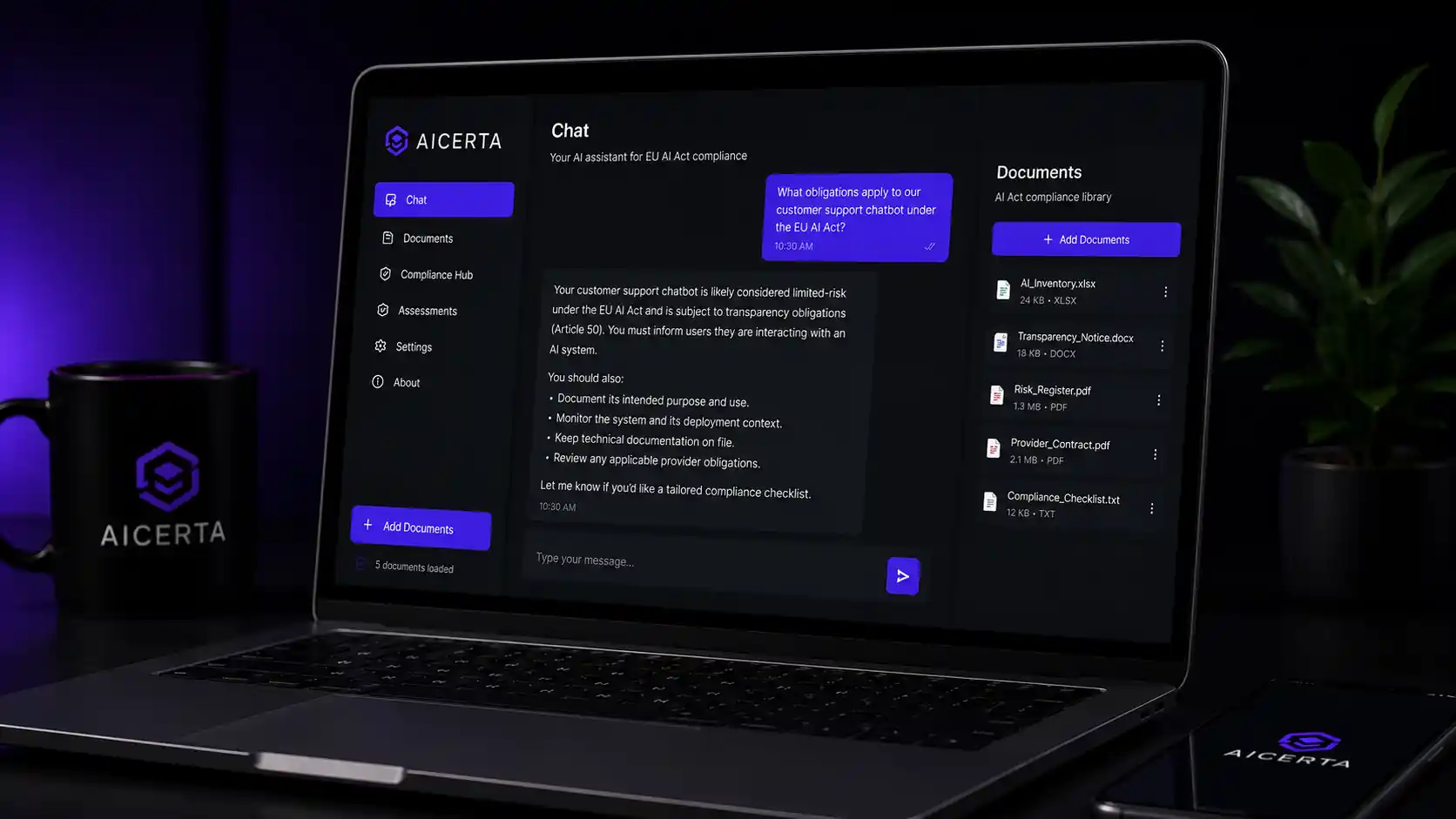
A small specialized model is only useful if it is built with discipline. The value here is not size, it is the pipeline: a curated dataset, a controlled fine-tune, and an honest reading of what actually improved.
The training data is a set of instruction and answer pairs written by hand, each one a real compliance question with a careful, source-grounded answer. It is deliberately small and specialized: the goal is to transfer a consistent, expert behaviour on a narrow domain, not broad coverage. On a regulated topic, one wrong answer costs more than a hundred missing ones.
We fine-tuned with QLoRA, training rank-16 adapters on the attention and MLP projections across all 28 layers of a 4-bit quantized base. That adds up to about 18.5 million trainable parameters, roughly one percent of the base model, and the result is a small, portable component that sits on top of an open base and can run locally. That choice is what makes private, on-premise deployment realistic instead of aspirational.
Where those parameters land is telling. The MLP projections carry far more adapter capacity than the attention ones, so most of the specialization lives in the feed-forward path.
| Module | Type | Parameters |
|---|---|---|
| down_proj | MLP | 4,702,208 |
| gate_proj | MLP | 4,702,208 |
| up_proj | MLP | 4,702,208 |
| q_proj | Attention | 1,376,256 |
| o_proj | Attention | 1,376,256 |
| k_proj | Attention | 802,816 |
| v_proj | Attention | 802,816 |
Training loss fell from 2.395 to 1.136, a 52.6% reduction, and validation loss reached its best point at step 40, not at the end of the run. The best checkpoint is not the last one. Picking it deliberately, at the point of best balance between specialization and generalization, is the difference between a model that learned the domain and one that memorised the dataset. It is the same discipline we write about in how to reduce AI hallucinations.
| Step | Training loss | Validation loss |
|---|---|---|
| 1 | 2.395 | |
| 5 | 2.34 | 2.18 |
| 10 | 1.97 | 1.83 |
| 15 | 1.70 | 1.69 |
| 20 | 1.55 | 1.61 |
| 25 | 1.42 | 1.55 |
| 30 | 1.32 | 1.52 |
| 35 | 1.24 | 1.505 |
| 40 | 1.19 | 1.500 |
| 45 | 1.15 | 1.506 |
| 50 | 1.136 | 1.506 |
Because the base is quantized to 4 bit and the specialized component is light, the whole model runs on ordinary hardware without a cloud round-trip. The company's documents, systems and questions never leave its own environment. For a tool whose entire subject is regulatory risk, that is not a nice-to-have, it is the point. It is the practical side of AI Act compliance.
A deliberately lean fine-tuning pipeline, chosen so the result stays small, reproducible and easy to deploy in place.
AI Certa is a custom language model end to end: dataset design, fine-tuning, validation and private deployment. It is the same work we do when we build custom LLMs and retrieval systems, and it sits right next to our AI Act compliance work. If you need a model that knows your domain and stays in-house, we can build it.
AI Certa is a specialized language model for EU AI Act compliance, fine-tuned for Italian SMEs. It answers questions about obligations, risk classification and documentation for a company's own AI systems, and it is small enough to run locally. ZenkeiX designed the dataset, trained the model and validated it.
Because the subject is regulatory risk. A private model runs on your own hardware, so your documents, systems and questions never leave your environment, and it is specialized on the AI Act rather than answering from general knowledge. It is the practical side of AI Act compliance.
With QLoRA on a 4-bit quantized base (Qwen2.5 1.5B Instruct), training rank-16 adapters on the attention and MLP layers over a curated dataset of compliance question-and-answer pairs. Training loss fell 52.6% and we kept the best-validating checkpoint, at step 40.
Yes. A 4-bit base with light LoRA adapters runs on ordinary hardware without a cloud round-trip, which is exactly what makes private deployment realistic. The trainable component is about 18.5 million parameters.
Yes. Dataset design, fine-tuning, validation and private deployment is the work we do for custom LLMs. Bring the domain, we handle the engineering.
For a narrow domain, yes. A curated set of high-quality examples transfers a consistent, expert behaviour better than scraped scale. On a regulated topic, one wrong answer costs more than a hundred missing ones.
We design, fine-tune and deploy private models end to end. Bring the domain, we handle the engineering.